The Challenge
A 1980s Lagoon, Out of Room
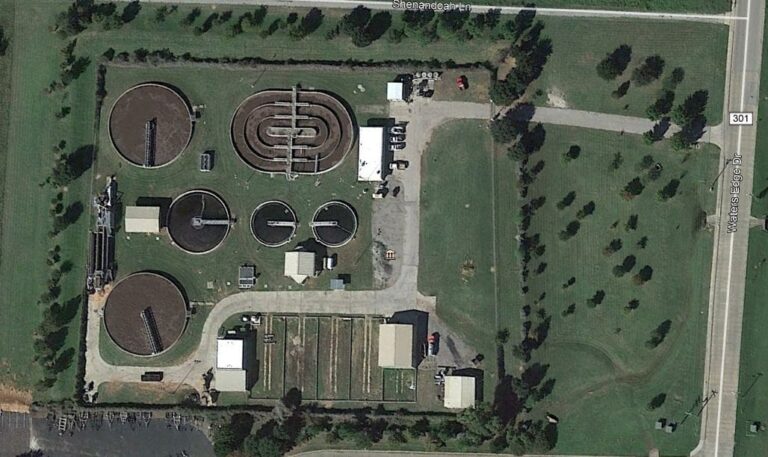
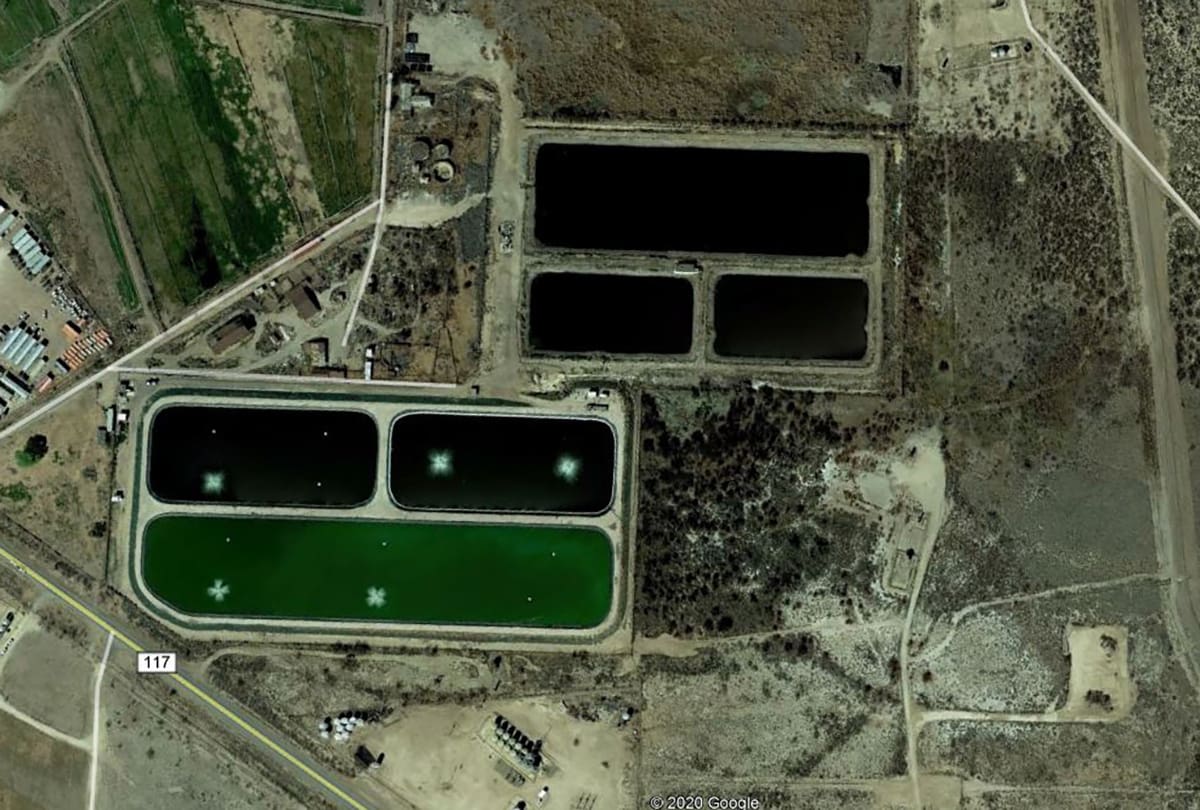
The Town of Pecos City’s wastewater treatment plant is a lagoon system built in the 1980s and permitted for 1.6 million gallons per day. In the Permian Basin, that was no longer enough. Oil-and-gas development has driven population and wastewater flows past what the lagoon was sized to carry — and a lagoon cannot simply be expanded the way a mechanical plant can. Its disposal route was also at its limit: the plant operated under a Texas Land Application Permit whose capacity was capped by the size of the town’s available land-application site. There was no more land to apply more water to.
A River With No Room for Nutrients
Pecos’s other option — discharging to the Pecos River — came with its own constraint. The receiving stretch of the Pecos River has virtually no assimilative capacity for the dilution of nutrients. Any new discharge permit for the added flow would therefore demand significant nutrient-removal capability — far more than a lagoon process can provide. The town was boxed in: it could not apply more effluent to land, and it could not discharge to the river without a fundamentally higher level of treatment.
Why this matters for Texas plants. Lagoon systems are common across rural and arid Texas, and many face the same double bind Pecos did: the land-application site is full, and the nearest receiving stream has little or no capacity to absorb nutrients. When both disposal paths are capped, the answer is not a bigger lagoon — it is a higher level of treatment. The project becomes about effluent quality as much as capacity.
The Solution
One Phase II Program — Lagoon to Mechanical Plant
The Town of Pecos City’s Phase II Wastewater Treatment Plant Improvements program — valued at roughly $57 million — replaces the lagoon with a full mechanical treatment plant and expands the design capacity from 1.6 MGD to 3.5 MGD. Enprotec Hibbs & Todd (eHT) of Abilene is the prime engineering firm on the project — providing planning, design, permitting, environmental clearance, and project management — supported by Parkhill of Lubbock. The new treatment train runs from coarse and fine mechanical screening, through grit removal, an influent pump station, and flow equalization, into a biological nutrient removal (BNR) process built for enhanced biological phosphorus removal, then membrane bioreactor (MBR) filtration, chlorination/dechlorination, and aerobic solids digestion. The permit path moves with it: from the land-application TLAP to a new TPDES permit for discharge to the Pecos River.
Designed for the Next Step: Potable Reuse
The BNR + MBR choice does more than satisfy a discharge permit. The plant is designed to produce TCEQ Type I reuse-grade effluent — the state’s highest reclaimed-water classification — and eHT specified the train so that effluent can later be polished further, to direct-potable-reuse quality, through reverse osmosis, UV advanced oxidation, ozone, and/or biologically active carbon, without rebuilding the plant. For a West Texas town whose own water supplies are limited, that is a deliberate hedge: the wastewater plant is being built today as a future water-supply asset, not just a disposal facility.
Equipment, Procured by Best Value
Pecos procured its major process equipment the way the Texas Municipal Code allows for high-technology procurement — owner-direct Requests for Proposals scored on a Best-Value weighted matrix rather than low bid. The 2021 RFPs weighted pricing at 50 points but put 50 more on experience, equipment quality, RFP conformance, and — heavily — regional service and parts availability. Each selected equipment price was then carried as an allowance line item into the general contractor’s separately bid construction contract. It is the same evaluated-bid path H2O Innovation’s “Flex” model is built to compete in, and the reason headworks screening and degritting — critical upstream processes that protect an MBR — were procured as deliberately as the membrane system itself.
Vision Equipment was invited to propose the screening, degritting, and membrane equipment. The table below is Vision Equipment’s internal project record; manufacturer attribution is not externally confirmed and is being verified against Vision Equipment’s records.
| Process step | Equipment | Manufacturer |
|---|---|---|
| Coarse screening | Mechanical coarse screens | Duperon |
| Fine screening | Mechanical fine screens | Cleantek |
| Grit removal | Tray degritting | Envirodyne Systems Inc. |
| Biological treatment | Membrane bioreactor | H2O Innovation |
No UV disinfection was required on this project; the plant uses chlorination/dechlorination.
The Results
Funded and Underway
The Texas Water Development Board approved a $51.36 million Clean Water State Revolving Fund loan to the Town of Pecos City in February 2021, drawn down in portions as the multi-phase project proceeds. Construction is being delivered in numbered phases: the Pecos City Council ratified the Phase 1 construction award to Smithco Construction in January 2025. The plant is targeted to come online in 2027.
| Milestone | Detail |
|---|---|
| TWDB CWSRF loan approved | February 2021 — $51,360,000 |
| eHT final design | 2021; equipment RFPs issued under Best-Value procurement |
| Phase 1 construction awarded | January 9, 2025 — Smithco Construction |
| Targeted online | 2027 |
| Capacity | 1.6 MGD lagoon → 3.5 MGD BNR + MBR |
A Plant Built for What West Texas Needs Next
When it comes online, the Pecos Main WWTP will more than double the town’s permitted treatment capacity, retire a 1980s lagoon, and produce effluent clean enough to carry a discharge permit on a nutrient-sensitive river. Just as important, it will leave Pecos with a treatment train that can be polished to drinking-water quality when the town is ready — turning a regulatory problem into a long-term water-supply option.
Implications for Texas Plants
Three replicable takeaways:
- A lagoon at its permit limit is a fundable program, not a crisis. Pecos’s lagoon was capped on capacity and on disposal — but the path out was a CWSRF-funded conversion to a mechanical BNR + MBR plant, financed years before any hard violation.
- When the receiving water has no room for nutrients, treatment level is the project. Capacity alone would not have earned Pecos a discharge permit. The Pecos River’s lack of assimilative capacity made nutrient removal — not just more gallons — the defining design driver.
- In water-short West Texas, design the upgrade to be reuse-ready. eHT specified BNR + MBR so the effluent can later be polished to potable-reuse quality. A wastewater upgrade built with reuse in mind becomes a future water-supply asset, even if reuse is a later phase.