
Oxidation Ditch Retrofit: Retrievable Fine-Bubble Aeration
- Oxidation Ditch
- Fine-Bubble Aeration
- Retrievable Racks
- Retrofit
- TCEQ Chapter 217
- Energy Efficiency
Executive Summary
Retrievable fine-bubble aeration restores dissolved oxygen (DO) in a failing oxidation ditch without dewatering the basin, and it is the least-cost path for many Texas WWTPs because of how the state treats removable aeration. Many oxidation ditches – originally designed for small plants with high TCEQ discharge limits – begin to fail as they operate near or beyond design capacity, particularly during high summer temperatures. Under 30 TAC 217.153(c)(1), a facility at or above 0.4 MGD design flow needs two aeration basins and two clarifiers – unless the aeration equipment, including the diffusers, is removable without taking the basin out of service. Retrievable racks are built for that condition, which is what can take a second basin off the project scope. Two of the referenced retrofits were installed in under one week with the ditch in service throughout, and Jaeger-Aeration cites aeration energy reductions of 20-50% against mechanical aeration.
The Problem: Why Oxidation Ditches Fail
Oxidation ditches were originally designed for small WWTPs with high TCEQ discharge limits. As Texas communities grow and permit limits tighten, many facilities are discovering their process lacks the ability to maintain required DO levels during high summer temperatures or high flows.
The process begins to fail as it operates near or beyond its design capacity. Contributing factors include:
- Reduced oxygen solubility at elevated water temperatures (Texas summers routinely exceed 100°F ambient)
- Increased biological oxygen demand as flows and organic loading increase
- Declining mechanical aerator efficiency due to bearing wear and shaft fatigue
- No redundant basins available for maintenance, creating single-point-of-failure risk
Without intervention, affected plants face incomplete nitrification, TN/TP compliance risk, and potential TCEQ enforcement action at their next permit renewal.
30 TAC 217.153(c)(1) requires a wastewater treatment facility with a design flow at or above 0.4 MGD to have a minimum of two aeration basins and two clarifiers, and exempts the aeration basins “if the aeration equipment, including the diffusers, is removable without taking the aeration basin out of service.” Retrievable systems are designed to meet that test, which is what makes them the least-cost path for a plant that would otherwise have to build a second basin. Whether the exemption applies to a given project is a determination for the engineer of record.
Two Paths for Restoring DO Levels
Option A: Aeration Supplement
When the existing process can be further utilized with supplemental aeration only, installation of retrievable strip aerators combined with blowers is sufficient. This is the lighter-touch option for plants that are approaching capacity but not yet requiring full process conversion.
Blowers can range from small VFD-controlled Positive Displacement (PD) Blowers to APG-Neuros Turbo Blowers for larger facilities where energy savings justify the investment. At the Mont Belvieu, TX reference below, the supplemental racks were paired with a United Blower, Inc. unit.
Option B: Full Process Conversion
When the capacity of the WWTP requires a large-scale performance realignment, a complete array of retrievable strip diffusers and blowers can be retrofitted in the existing basins. This full conversion returns the process to specified DO levels while addressing the removable-aeration provision of 30 TAC 217.153(c)(1).
Because the racks lift out for service without taking the basin out of service, a full conversion is the configuration that can support the redundancy exemption rather than a second basin. Anoxic zones are retained. BNR capability is achievable – the strip aerators include internal check valves to prevent fouling with intermittent use, enabling controlled anoxic/aerobic cycling for nitrogen removal.
| Factor | Option A: Supplement | Option B: Full Conversion |
|---|---|---|
| Scope | Add retrievable diffusers to supplement existing aerators | Replace all mechanical aeration with retrievable fine-bubble system |
| Best For | Plants approaching capacity, seasonal DO issues | Plants requiring full performance realignment or BNR |
| BNR Capable | Limited | Yes – TN < 5 mg/L, TP < 1 mg/L achieved at Jaeger-Aeration reference plants |
| Installation Time | Under one week at the Mont Belvieu, TX reference (2026) | Under one week at Farmington, MO, outside pre-installation work; larger plants run to a project schedule |
| Basin Dewatering Required | No | No |
| Capital Cost | Lower | Moderate (offset by energy savings and an avoided second basin) |
The Technology: Jaeger-Aeration OxyStrip & OxyLift
Jaeger-Aeration has been the pioneer of fine-bubble aeration since 1973, when it introduced the membrane disc diffuser (Jaeger-Aeration). Its retrievable system consists of two key components:
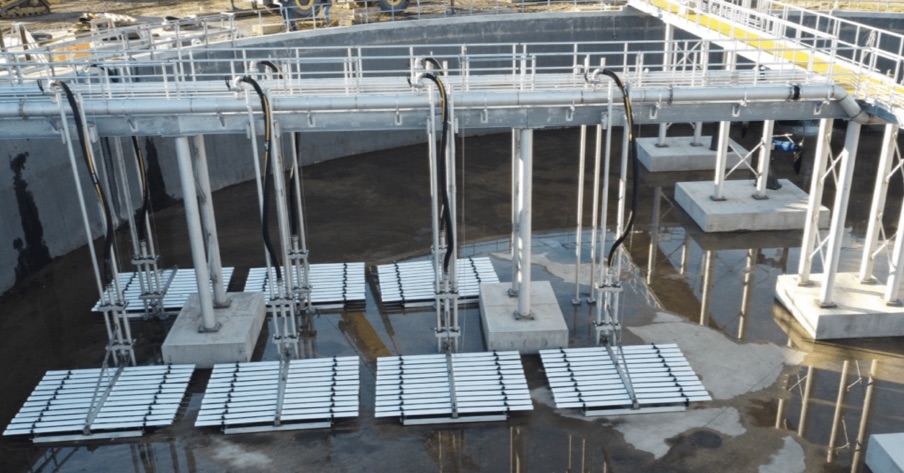
- OxyStrip™ fine-bubble diffusers – strip-type diffuser elements that mount on retrievable racks. Jaeger-Aeration also supplies fixed-grid OxyDisc™ and OxyTube™ diffusers.
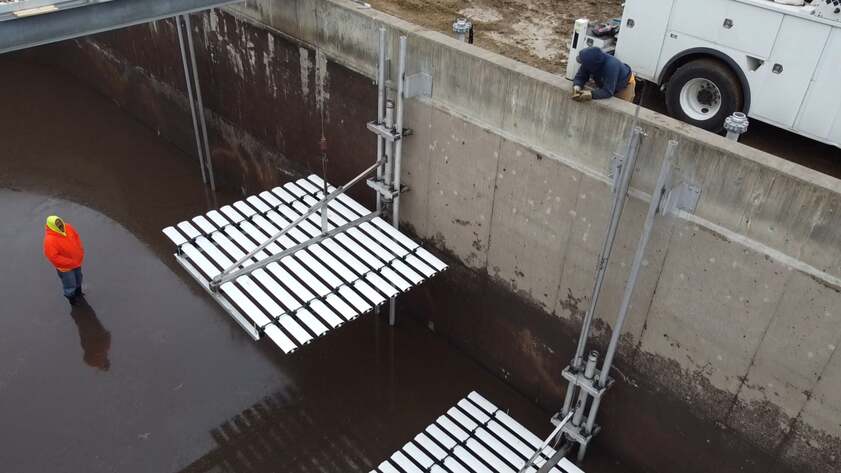
- OxyLift™ retrieval system – bridge-mounted or wall-mounted rack design that allows each diffuser assembly to be lifted with a portable hoist, placed on an OxyCart, and moved to the basin edge for servicing. Standard feature – no crane required.
| Parameter | Specification |
|---|---|
| Oxygen Transfer Efficiency | About 3 lb O₂/hp-hr for mechanical aerators vs more than 5 lb O₂/hp-hr for fine-bubble diffusers (Jaeger-Aeration) |
| Energy Savings vs Mechanical | 20-50% aeration energy reduction (Jaeger-Aeration) |
| Basin Configurations | Round, oxidation ditch, rectangular |
| BNR Performance | TN < 5 ppm, TP < 1 ppm achieved at Jaeger-Aeration reference plants (Farmington, MO; Freeburg, IL) |
| Retrieval Time | About two minutes per rack (Jaeger-Aeration); no crane required |
| Mounting Options | Bridge-mounted with hoist or wall-mounted design |
| TCEQ 217 Compliance | Racks are removable without taking the basin out of service |
| Check Valves | Internal check valves prevent fouling during intermittent use |
| Diffuser Types Available | OxyStrip™, OxyDisc™, OxyTube™ |
Texas and Regional Installation References
Jaeger-Aeration has two operational oxidation ditch retrofits in Texas, supplied by Vision Equipment – Mont Belvieu (2026) and Huntsville. Long-term references in Missouri and Georgia are described below, and additional regional references are available on request.
| Location | Type | Status |
|---|---|---|
| Mont Belvieu, TX | Oxidation ditch retrofit (OxyLift wall-mounted retrievable racks, supplemental air) | Operational (2026) |
| Huntsville, TX | Oxidation ditch retrofit | Operational |
| Farmington, MO | OxyStrip retrofit (12 aspirating aerators replaced with 4 OxyStrip units) | Long-term reference |
| Gainesville, GA | OxyLift retrofit (12 MGD, supplemental fine-bubble air added to existing aerator/mixers) | Long-term reference |
| Palmyra, MO | OxyLift replaced a failed rotor in a two-rotor oxidation ditch, installed without dewatering | Long-term reference |
Mini Case Study: City of Mont Belvieu, Texas
Wall-Mounted OxyLift Racks Restore DO in 24 Hours With the Ditch in Service
The City of Mont Belvieu’s Cotton Bayou WWTP oxidation ditch was running at 0.5 mg/L dissolved oxygen against a plant target of 1.5 to 2.5 mg/L. Vision Equipment supplied Jaeger-Aeration OxyLift wall-mounted retrievable racks with a United Blower, Inc. blower as supplemental aeration. The system started on August 11, 2026.
- Installation completed in under one week
- Ditch in service throughout – no bypass pumping, no dewatering, no interruption to treatment
- Dissolved oxygen rose from 0.5 mg/L to 0.95 mg/L within 90 minutes and to 1.95 mg/L within 24 hours of startup, inside the plant’s operating range
- Future rack cleaning and service do not require dewatering the basin
Mini Case Study: City of Farmington, Missouri
OxyStrip Retrofit Cuts Metered Aeration Energy Roughly in Half
The plant’s aspirating aerators had failed and the oxidation ditch could not hold DO reliably. Jaeger-Aeration supplied a retrievable OxyStrip diffuser system, replacing twelve aspirating aerators with four OxyStrip units installed directly in the oxidation ditch. Basin installation took under one week, outside pre-installation work. The project was named a Water & Wastes Digest 2023 Top Project.
- Aeration-basin power fell from 80,000-90,000 kWh/month to under 40,000 kWh/month on a dedicated meter (Jaeger-Aeration)
- About $6,000/month saved in aeration energy (Jaeger-Aeration)
- Basin installation completed in under one week
- Effluent TN < 5 mg/L and TP < 1 mg/L (Jaeger-Aeration)
- Retrievable racks introduced aeration redundancy to the process
Mini Case Study: City of Gainesville, Georgia
Retrievable OxyLift Adds Supplemental Air to an Operating 12 MGD Plant
The plant’s existing vertical aerator/mixers could not supply enough oxygen, especially in summer, and the basins could not be taken out of service. Hazen and Sawyer sized the supplemental air, and Jaeger-Aeration’s OxyLift and OxyStrip retrievable fine-bubble system was installed by Reeves Young in the operating basins while the plant maintained its 12 MGD flow. The retrievable rack design provides process redundancy for all future maintenance.
- Installed in the wet – the basins stayed in service throughout
- Delivered under budget and on schedule on a six-month construction schedule
- 20 levels of aeration redundancy per train where there had been none
- 16,000 scfm installed, designed for 32,000 scfm future capacity across both trains
- Improved TN/TP performance through VFD-based dissolved oxygen control
- Racks lift out with a portable hoist onto an OxyCart – no crane required
Implications for Texas Plants
If your oxidation ditch is experiencing seasonal DO deficiencies or is operating near its design capacity, the window for proactive action is now. Key considerations for Texas facilities:
- TCEQ Chapter 217: 30 TAC 217.153(c)(1) exempts aeration basins from the two-basin requirement where the aeration equipment, including the diffusers, is removable without taking the basin out of service. Retrievable racks are built for exactly that condition – whether the exemption applies to your project is a determination for your engineer of record.
- Energy: Jaeger-Aeration cites a 20-50% aeration energy reduction for retrievable fine-bubble retrofits versus mechanical aeration; the Farmington, MO installation is metered at about $6,000/month saved (Jaeger-Aeration).
- Permit renewal preparation: If your TPDES permit renewal includes tighter nutrient limits, Jaeger-Aeration reference plants with retrievable fine-bubble racks report TN < 5 mg/L and TP < 1 mg/L in their existing basins
- Speed of deployment: The Mont Belvieu, TX and Farmington, MO installations each took under one week, with the ditch in service; a retrievable aeration retrofit can be operational in weeks rather than a construction season
Vision Equipment can provide a preliminary assessment of your oxidation ditch’s suitability for retrievable aeration retrofit. Contact your regional representative or call David Bartlett at (210) 381-4030. If your facility requires a mechanical aeration solution rather than fine-bubble conversion, see our companion Tech Memo, Brush Rotor to Disc Rotor Conversion for Oxidation Ditches, with Envirodyne Systems.
References and Sources
- Texas Commission on Environmental Quality. “Chapter 217: Design Criteria for Domestic Wastewater Systems.” 30 TAC §217 – redundancy and removable aeration at 30 TAC 217.153(c)(1).
- Jaeger-Aeration. “Technical Details” and “Retrievable” product pages, jaeger-aeration.com (accessed 2026-09-10): oxygen transfer of mechanical aerators vs fine-bubble diffusers, 20-50% energy reduction, two-minute rack retrieval, company timeline.
- Jaeger-Aeration. “Retrievable Case Histories” (№102 Farmington, MO; №104 Palmyra, MO; №105 Freeburg, IL; №106 Energy Savings, Farmington, MO) and “Farmington MO Case History,” jaeger-aeration.com. Farmington East WWTP named a Water & Wastes Digest 2023 Top Project.
- Vision Equipment. “Gainesville, GA – Flat Creek WWTP: Retrievable Fine-Bubble Aeration Installation.” Video: https://youtu.be/jrx6vHFMT2c. Project also described in the Jaeger-Aeration advertorial, Water Quality Industry News, WEFTEC 2025 edition.
- Vision Equipment. “Brush Rotor to Disc Rotor Conversion for Oxidation Ditches” – Tech Memo, Winter 2026.
- Vision Equipment. “Restore DO Levels in Oxidation Ditches with Retrievable Fine-Bubble Aeration – Tech Memo.” Winter 2026, revised September 2026.
- Vision Equipment. Reference letter on the Mont Belvieu, TX (Cotton Bayou WWTP) oxidation ditch retrofit with OxyLift wall-mounted retrievable racks, Hershel Ezzell, Jr., P.E., 2026-09-01 (on file).
- Jaeger-Aeration: Retrievable Case Studies Six Jaeger-Aeration case histories of retrievable aeration retrofits, including Farmington, MO (metered energy savings) and Palmyra, MO (oxidation ditch). · 3 MB Download
- Jaeger-Aeration: OxyProcess Design System OxyStrip and OxyLift product and design documentation for new and retrofit oxidation ditch aeration. · 5 MB Download
- APG-Neuros Turbo Blowers: Product Brochure High-efficiency turbo blower line. The blower side of a full retrievable conversion at larger plants. · 6 MB Download
- Maximizing Aeration System Energy Efficiency (WE&T) Water Environment & Technology feature on Cincinnati's aeration energy efficiency across three facilities. · 1 MB Download

Frequently Asked Questions
Why is my oxidation ditch failing to maintain DO levels?
Oxidation ditches were originally designed for small WWTPs with high TCEQ discharge limits. Many begin to fail as the process operates near or beyond design capacity, particularly during high summer temperatures when reduced oxygen solubility and increased biological demand combine to create persistent low DO levels. Aging mechanical aerators (brush rotors, surface aerators) compound the problem through declining oxygen transfer efficiency.
What does TCEQ Chapter 217 require for oxidation ditch aeration?
30 TAC 217.153(c)(1) requires a wastewater treatment facility with a design flow at or above 0.4 MGD to have a minimum of two aeration basins and two clarifiers. It exempts the aeration basins from that requirement “if the aeration equipment, including the diffusers, is removable without taking the aeration basin out of service.”
Retrievable racks are designed for exactly that condition, which is what can take a second basin off a project’s scope. Whether the exemption applies to your facility is a determination for your engineer of record – Chapter 217 governs facilities constructed or renovated after its adoption and does not otherwise reach existing plants.
How long does it take to retrofit an oxidation ditch with retrievable aeration?
Retrievable fine-bubble aeration retrofits can be completed in as little as one week. The City of Mont Belvieu’s Cotton Bayou WWTP was fitted with OxyLift wall-mounted racks in under one week in 2026 with the ditch in service throughout, and the City of Farmington, Missouri completed its OxyStrip basin installation in under one week, outside pre-installation work. Larger installations such as Gainesville, GA (12 MGD) were installed in the wet, with the basins kept in service, on a longer project schedule.
How much energy can a retrievable aeration retrofit save?
Jaeger-Aeration rates mechanical aerators at about 3 lb O₂ per horsepower-hour and fine-bubble diffusers at more than 5 lb O₂/hp-hr, and cites a 20-50% aeration energy reduction for retrievable fine-bubble retrofits versus mechanical aeration. At the City of Farmington, Missouri, metered aeration-basin power fell from 80,000-90,000 kWh/month to under 40,000 kWh/month, about $6,000 per month in aeration energy (Jaeger-Aeration).
Can retrievable aeration achieve BNR performance in an oxidation ditch?
Jaeger-Aeration reference plants with retrievable fine-bubble racks report TN below 5 mg/L and TP below 1 mg/L (Farmington, MO; Freeburg, IL). The strip aerators include internal check valves to prevent fouling during intermittent use, enabling controlled anoxic/aerobic cycling for nitrogen removal while maintaining existing anoxic zones in the ditch.
Do I have to take the basin out of service to install or service retrievable aeration?
No. That is the point of the retrievable design. Each diffuser assembly mounts on a rack that lifts with a portable hoist – bridge-mounted or wall-mounted – and moves to the basin edge on an OxyCart for servicing. No crane, and the basin stays in service.
Retrofits are typically installed with the basin in service. The City of Mont Belvieu’s Cotton Bayou WWTP stayed in service throughout its 2026 OxyLift installation, which took under one week, and the Farmington, MO basin installation was also completed in under one week.
Should I choose retrievable fine-bubble aeration or a disc rotor conversion?
It depends on what is failing and what you need from the upgrade. A disc rotor conversion from Envirodyne Systems is the lower-disruption path when worn brush rotors are the problem and the basin, drive platform and torque tube are sound – it is a direct mechanical replacement in the same footprint.
Retrievable fine-bubble aeration is the path when you need maximum oxygen transfer, BNR performance, or aeration equipment that can be serviced without taking the basin out of service. A disc rotor is fixed and shaft-mounted, so it does not meet the removability test in 30 TAC 217.153(c)(1).
Is Your Oxidation Ditch Underperforming?
Our team can assess your facility and recommend the right upgrade path - aeration supplement or full conversion.
Talk to Our Experts
Serving Texas municipalities with proven water and wastewater treatment technologies from six strategic offices across the state.
© 2026 Vision Equipment. All rights reserved.